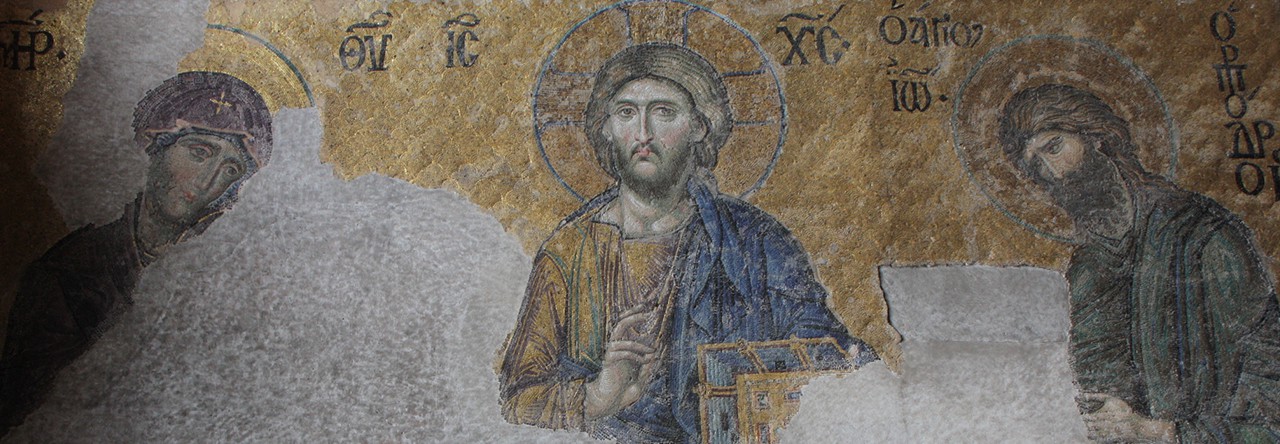
He Heals our Diseases

Now Jesus was teaching in one of the synagogues on the Sabbath. And behold, there was a woman who had a spirit of infirmity eighteen years and was bent over and could in no way raise herself up. But when Jesus saw her, He called her to Himself and said to her, “Woman, you are loosed from your infirmity.” And He laid His hands on her, and immediately she was made straight, and glorified God. But the ruler of the synagogue answered with indignation, because Jesus had healed on the Sabbath; and he said to the crowd, “There are six days on which men ought to work; therefore come and be healed on them, and not on the Sabbath day.” The Lord then answered him and said, “Hypocrite! Does not each one of you on the Sabbath loose his ox or donkey from the stall, and lead it away to water it? So ought not this woman, being a daughter of Abraham, whom Satan has bound – think of it – for eighteen years, be loosed from this bond on the Sabbath?” And when He said these things, all His adversaries were put to shame; and all the multitude rejoiced for all the glorious things that were done by Him. (Luke 13:10-17)

In this Gospel lesson Christ rejects the idea that suffering is good for us, but rather clearly attributes this woman’s suffering to Satan – He releases her from that suffering. Christ’s words to the woman put to shame those who thought she should not come to be healed on the Sabbath but rather should continue suffering until some other day. Suffering is a burden imposed on us by Satan, not God. Jesus is moved to compassion when seeing the women in her suffering. The “righteous” synagogue ruler doesn’t connect the Sabbath with God’s mercy and our rest from the burden of suffering nor with humans being freed from suffering. His piety is that suffering is what God wills for us. Contrariwise, Christ clearly blames Satan for inflicting this poor woman for 18 years. Christ teaches that suffering belongs to the fallen world, it is not part of the Kingdom of God – which is why Christ heals the sick and gives power to His disciples to do the same (for examples, see Matthew 4:24; Luke 4:40 and 9:1). Christ’s healing ministry fulfills the promises and prophecies of God, such as what Isaiah said: He took our infirmities and bore our diseases” (Matthew 8:17). And David’s words: “who forgives all your iniquity, who heals all your diseases” (Psalm 103:3).

As God’s kingdom breaks into this world, suffering is exposed for what it is – Satan’s action against humanity. It is Satan who wants humans to suffer. Christ is going to use such suffering to destroy death, sin and suffering.

It is true that some suffering can cause us to seek out God, but that doesn’t make the suffering godly. God banishes suffering from His presence and comforts His people rather than demanding more suffering from them. There certainly is some pieties which think if you are not suffering, you aren’t on the right path, but Christ takes on Himself our suffering to deliver us from the power of Satan. But my guess is this piety results from the fact that despite what Christ accomplished, suffering continues to be part of our experience in this world of the Fall.  We try to make the best of this reality by embracing suffering for the sake of the Kingdom – we share in Christ’s suffering which brought about our salvation. In the bible, God’s promise is eventually to eliminate suffering and to comfort us:

I heard a loud voice from the throne saying, “Behold, the dwelling of God is with men. He will dwell with them, and they shall be his people, and God himself will be with them; he will wipe away every tear from their eyes, and death shall be no more, neither shall there be mourning nor crying nor pain any more, for the former things have passed away.” (Revelation 21:3-4)

The One Who Exists

… you are Christ’s; and Christ is God’s. (1 Cor 3:23) 

Whether we believe or not, we belong to God. Whether we understand it or not, or feel His presence or not, or rejoice in that presence or not, He exists. He is my God. He is my Lord. Even during moments of darkness and terror when God doesn’t exist for me, He still exists. When I feel I’m a failure, when all my efforts seem fruitless, when my life seems to have passed in vain, Christ is still my Christ. He is there for me no matter what happens. He exists irrespectively of my capabilities, capacities, and comprehension. I might imagine that God is small. But God is great. I might think that God doesn’t hear. But he does. And He has given Himself entirely to me, so that there’s only one possibility of failure: for me to break off my relationship with the One Who exists (Exodus 3:14). 

… the mystery of the enormous love whereby God overlooks my utter nothingness; a love that renders Him immune, as it were, to my own will or actions. God remains the God of love, the God of majesty, the God of glory, the God of strength, the God Who achieves anything He wants to. And as He was to all the apostles, the prophets, and the saints, so He is to me, however small, sinful, destitute, and worthless I may be. (Archimandrite Aimilianos, THE WAY OF THE SPIRIT, pp 165-166)

For with God nothing will be impossible. (Luke 1:37)

A Belief in God is also a Belief in the Miraculous 

And the Word became flesh and dwelt among us, full of grace and truth; we have beheld his glory, glory as of the only Son from the Father. (John 1:14) 

Conservative commentator Eric Metaxas says of God’s incarnation in Jesus Christ: 

We human beings live in the natural world, the world of nature and matter and time. To fathom what it might mean for something to come into our world of space and time from beyond the world of space and time is not easy. But if we believe that there is a God who created this world of space and time, we have already accepted the idea of the miraculous. (MIRACLES, p 330) 

While creation itself is a miracle, God reveals a bigger miracle in God’s incarnation into this world.  It is God who reopens the intimate connection between humans and the divine. It is Christ who ends all that separates us from our Creator. Mataxas writes:   

Heaven had suddenly been opened to us. Jesus had opened it and we could take that path.  

There had once been no barrier between us and God and eternity. In the Garden of Eden, God walked with Adam and Eve. There was no separation between him and creation. But in the Fall, however one interprets that story, the liberty we once had came to an abrupt end. It is the infinitely tragic story of our leaving eternity and God’s presence, of our being exiled from our true home. So the story of Jesus is the story of Jesus rescuing us and bringing us back where we belong, where we were created to be in the first place. (MIRACLES, p 331) 

I say, “You are gods, sons of the Most High, all of you …” (Psalm 82:6-7) 

Thanksgiving Day (2025)

Let them thank the LORD for his steadfast love, for his wonderful works to the sons of men! For he satisfies him who is thirsty, and the hungry he fills with good things. (Psalm 107:8-9) 

St John Chrysostom recites the prayer of thanksgiving that monks in the 4th Century offered after eating dinner. He invites everyone to use this prayer following their main meal: 

‘Blessed be God, who has nourished me from my youth, and given nourishment to every being. Fill our hearts with joy and gladness, so that we may always have everything we need and may abound in every good work in Christ Jesus our Lord; with Him and the Holy Spirit be glory, honor, and might to you forever. Amen.

Glory to you, Lord, glory to you, Holy One, glory to you, King, for giving us food to enjoy. Fill us with the Holy Spirit so that we may be found pleasing in your sight, unashamed when you render to everyone according to their deeds.’ (SPIRITUAL GEMS FROM THE GOSPEL OF MATTHEW, p 103-104)

Nature Speaks of God

What sort of praise can I give you? I have never heard the song of the cherubim, a joy reserved for the spirits above. But I know the praises that nature sings to you.

In winter, I have beheld how silently in the moonlight the whole earth offers you prayer, clad in its white mantle of snow, sparkling like diamonds.

I have seen how the rising sun rejoices in you, how the song of the bird is a chorus of praise to you.

I have heard the mysterious murmurings of the forests about you, and the winds singing your praise as they stir the waters.

I have understood how the choirs of stars proclaim your glory as they move forever in the depths of infinite space.


What is my poor worship? All nature obeys you, I do not. Yet while I live, I see your love, I long to thank you, pray to you and call upon your name.

(Akathist: Glory to God for All Things)


Disoriented by the ‘Orient from on High’

And the Lord said, “I am the God of your father, the God of Abraham, the God of Isaac, and the God of Jacob.” And Moses hid his face, for he was afraid to look at God. (Exodus 3:6)

In the tropar for the Nativity of Christ  we call the Lord Jesus “the orient from on high.” In Christ we encounter God, which as many saints have noted is a disorienting experience. Metropolitan Kallistos Ware comments:

The Greek Fathers likened man’s encounter with God to the experience of someone walking over the mountains in the mist; he takes a step forward and suddenly finds that he is on the edge of a precipice, with no solid ground beneath his foot but only a bottomless abyss. Or else they use the example of a man standing at night in a darkened room: he opens the shutter over a window, and as he looks out there is a sudden flash of lightning, causing him to stagger backwards, momentarily blinded.

Such is the effect of coming face to face with the living mystery of God: we are assailed by dizziness; all the familiar footholds vanish, and there seems nothing for us to grasp; our inward eyes are blinded, our normal assumptions shattered. (THE ORTHODOX WAY, p 15)


Soil, Sun and Rain – God’s Gifts to Enable Our Charity (II)

Then He spoke a parable to them, saying: “The ground of a certain rich man yielded plentifully. And he thought within himself, saying, ‘What shall I do, since I have no room to store my crops?’ So he said, ‘I will do this: I will pull down my barns and build greater, and there I will store all my crops and my goods. ‘And I will say to my soul, “Soul, you have many goods laid up for many years; take your ease; eat, drink, and be merry.”’ But God said to him, ‘Fool! This night your soul will be required of you; then whose will those things be which you have provided?’ So is he who lays up treasure for himself and is not rich toward God.” (Luke 12:16-21)

This is the conclusion to yesterday’s post [Soil, Sun and Rain – God’s Gifts to Enable Our Charity (I)] in which we began considering Christ’s parable quoted above.

In the Great Litany of our liturgies, we pray: “For seasonable weather, for abundance of the fruits of the earth, and for peaceful times, let us pray to the Lord.” We do pray to God to give us what the rich fool in the above parable already had! Receiving and enjoying prosperity in itself is not the problem. The sin comes when our prosperity causes us to become miserly, close-fisted and uncharitable. We go into self-preservation mode and instead of denying the self to serve the Lord and our fellow humans, we grasp onto what we have received and treat it not as a gift given to us to joyfully share with others, but as our personal property which others are threatening to take away from us.  We will even justify the use of lethal force to hold onto our worldly goods, defying the Gospel of our Lord Jesus Christ.

Fr Lawrence Farley writes of the above litany:

Long before it became fashionable to be ‘green,’ long before journalists spoke about ecology and the environment,  . . . the Church knew of the importance of soil and weather, of earth and sky. Food does not come from the supermarket, whatever city dwellers might imagine. It comes from the earth, and its harvest and supply depend on seasonable weather, on rain and sunshine, on freedom from drought and blight and war. Thus our food and welfare come ultimately from God. (LET US ATTEND, p 19)

Our food comes from the soil, rain and sunshine that God provides to everyone on earth (Matt 5:45).  It is given to us so that we might enjoy the abundance of the fruits of the earth, but also so that we enable others, especially the less fortunate, to enjoy God’s gifts as well.

And God is able to provide you with every blessing in abundance, so that you may always have enough of everything and may provide in abundance for every good work. As it is written, “He scatters abroad, he gives to the poor; his righteousness endures for ever.” He who supplies seed to the sower and bread for food will supply and multiply your resources and increase the harvest of your righteousness. You will be enriched in every way for great generosity, which through us will produce thanksgiving to God; for the rendering of this service not only supplies the wants of the saints but also overflows in many thanksgivings to God. (2 Cor 9:8-12)

Soil, Sun and Rain – God’s Gifts to Enable Our Charity (I)

Then He spoke a parable to them, saying: “The ground of a certain rich man yielded plentifully. And he thought within himself, saying, ‘What shall I do, since I have no room to store my crops?’ So he said, ‘I will do this: I will pull down my barns and build greater, and there I will store all my crops and my goods. ‘And I will say to my soul, “Soul, you have many goods laid up for many years; take your ease; eat, drink, and be merry.”’ But God said to him, ‘Fool! This night your soul will be required of you; then whose will those things be which you have provided?’ So is he who lays up treasure for himself and is not rich toward God.” (Luke 12:16-21)

In this post and the next, we will consider two very different messages from Christ’s parable. First:

The parable rejects the ‘prosperity Gospel’ – the notion that God promises each of us to be affluent. Affluence in itself will do us little good for gaining God’s favor or avoiding God’s judgment (think about Christ’s parable of the Last Judgment, partially quoted below). The prosperity Gospel is another example of Christians trying to get around Jesus’ Gospel command that we cannot serve both God and mammon (Matt 6:24). For Christians, our true wealth is in heaven, for it is not the earthly kind, just as Christ’s kingship is not of this world (John 18: 36). That is why we are to seek first the kingdom (Matt 6:33), not the blessings of a prosperous life on earth (which tends towards selfishness and self-centeredness, the opposite of Christ’s teaching on self-denial in Mark 8:34).

The man in the above parable learns that lesson the hard way – he dies before he can enjoy his prosperity, and he can’t take it with him, so he won’t enjoy it in the life to come either. Christianity teaches that if we want to enjoy our prosperity in the heavenly kingdom, we need in this world to share it with the poor and needy – God will reimburse us in His kingdom for sharing our hard-earned prosperity with those less fortunate than we are. What we give to the poor we lend to God (Prov 19:17) who promises to repay us in His kingdom (see Matt 10:42; Luke 6:38; 2 Cor 9:6; Heb 6:10).

[Note that while the man in the parable decides foolishly to build bigger barns to store his ‘goods’, we are no different than him when we fill our attics, basements, garages, sheds and rented storage spaces with more stuff than we could ever need or use, rather than selling some of it to give to the poor. Just because we don’t build bigger barns, doesn’t mean we are not like the foolish man. We shouldn’t avoid the Gospel commands by trying to hide behind shameless biblical literalism.]

“When the Son of man comes in his glory, and all the angels with him, then he will sit on his glorious throne. Before him will be gathered all the nations, and he will separate them one from another as a shepherd separates the sheep from the goats, and he will place the sheep at his right hand, but the goats at the left. Then the King will say to those at his right hand, ‘Come, O blessed of my Father, inherit the kingdom prepared for you from the foundation of the world; for I was hungry and you gave me food, I was thirsty and you gave me drink, I was a stranger and you welcomed me, I was naked and you clothed me, I was sick and you visited me, I was in prison and you came to me.’ Then the righteous will answer him, ‘Lord, when did we see thee hungry and feed thee, or thirsty and give thee drink? And when did we see thee a stranger and welcome thee, or naked and clothe thee? And when did we see thee sick or in prison and visit thee?’ And the King will answer them, ‘Truly, I say to you, as you did it to one of the least of these my brethren, you did it to me.’ (Matthew 25:31-40)

Next: Soil, Sun and Rain – God’s Gifts to Enable Our Charity (I)

The Credible Sign of the Virgin Birth of Christ 

Therefore the Lord himself will give you a sign. Behold, a young woman shall conceive and bear a son and shall call his name Immanuel. (Isaiah 7:14) 

In one of his sermons, St Basil the Great notes that he is well aware of a controversy between Christians and Jews regarding the interpretation of Isaiah 7:14 – should the text read that “a young maiden” shall give birth to the Messiah or should it read “a virgin”? While the original Hebrew uses a word that can be translated either way, when the Jews translated their Scriptures into Greek (the Jewish translation of their scriptures into Greek is called the Septuagint), the Jews chose to render the prophecy as “a virgin.” Basil thinks this is totally reasonable because a virgin birth is something miraculous and thus a good sign from God.

Rendering the text to read “a young maiden shall conceive” is hardly a miraculous sign from God at all since young maidens get pregnant all the time as a normal part of life. Basil faults the Jews of his day for eliminating the prophecy of a Virgin giving birth – he says it is just their polemics to discredit Christianity. In discrediting Christianity, they also discredit God by eliminating a divine sign which could only be from God. 

Basil writes:

And no one should be misled by the captiousness of the Jews, who claim the Prophet used the word ‘maiden’ instead of ‘virgin,’ as in, ‘Behold, a maiden shall conceive.’ In the first place, it is a mark of the utmost irrationality to think that what the Lord gave as a sign would be something so ordinary and taken for granted by everyone. For what does the Prophet say? ‘And again the Lord spoke to Ahaz saying: “Ask a sign from the Lord your God, in the depth or in the height.” And Ahaz said, “I will not ask, and I will not put the Lord to the test! Then a little bit after he said: ‘Therefore the Lord himself will give you a sign. Behold, the Virgin shall conceive.’ Seeing that Ahaz did not ask a sign ‘in the depth or in the height,’ so that you could learn that ‘he who descended to the lower parts of the earth is he who ascended above all the heavens,’ the Lord Himself gave a sign. And this sign is something incredible and wonderful, and quite contrary to the ordinary nature of things.

The same woman is both a virgin and a mother, remaining in the holy condition of her virginity while allotted the blessing of childbearing. But if some have rendered it ‘maiden’ instead of ‘virgin’ based on their interpretation of the Hebrew term, nothing is ruined by using this word. For we have found in the customary usage of Scripture that ‘maiden’ is often used instead of ‘virgin.’ For example, in Deuteronomy it says: ‘If a man meets a young virgin who is not betrothed, and seizes her and lies with her, and he is found, then the man who lay with her shall give to the father of the maiden 50 double-drachmas’ (Deuteronomy 22:28-29). (ON FASTING AND FEASTS, pp 33-34)

Sharing in the Blessedness of the Virgin Mary

Today the Orthodox Church celebrates the Feast of The Entry of the Theotokos into the Temple.  The event celebrated is not found in the canonical Scriptures but is reported in ancient Christian apocryphal texts. [Today, even some Orthodox scholars admit the event could not have happened as described in the apocryphal literature for it is based in a Greek pagan understanding of a temple, rather than on what the Temple in Jerusalem actually was.] Because the narrative fit well into the emerging piety for the Theotokos, it eventually was adopted by the Church for its theological implications. All Feasts have a Gospel reading associated with them; part of the Gospel reading for this feast of the Virgin includes these verses: 

And it happened that as Jesus was saying these things a certain woman raised her voice and said to him from the crowd, “How blissful the womb having borne you and the breasts from which you sucked.” But he said, “Blissful, rather, those hearing God’s word and keeping it.” (Luke 11:27-28)

In the above quote from the Gospel of St Luke, some have interpreted Christ’s words to mean he minimizes the importance of His Mother in salvation and rather praises only His faithful followers.

During the Council of Ephesus (431AD), Proclus, the Archbishop of Constantinople (d. 446AD) was tasked with writing hymns about Mary the Theotokos. One hymn he composed to praise Mary begins by denying that Christ ever downplayed her role in the salvation of the world. Rather than devaluing Mary’s role, Christ’s comment lifts the status of all believers in God’s eyes – anyone who hears God’s word and keeps it shares in the praise that is due to the Theotokos.  All believers have their status raised in God’s eyes because of and along with the Virgin Mary. Proclus penned these words:

Christ does not diminish the role of His mother. Rather He focuses not on her unique role but rather expansively bestows to all who listen to Him the blessings of the kingdom. And so we now acclaim Mary the Virgin Theotokos. She is the unstained treasurer of virginity. She is the paradise of the second Adam. She is the workshop of the union of natures, the festival of the covenant of salvation. She is the bridal chamber wherein the Logos married all flesh. She is the living thorn bush of our nature which the flame of divine birthpangs did not consume.

She is the refreshing rain- cloud, emitting him bodily, and is higher than the Cherubim. She is the purest fleece, heavenly endewed, whereby the Shepherd clothed the sheep. Mary: Servant, Mother, Virgin, Paradise. The only bridge from God to humankind: awe-inspiring loom of the whole wide world on which the robe of union was ineffably woven. (ILLUMINED IN THE SPIRIT, p 23)