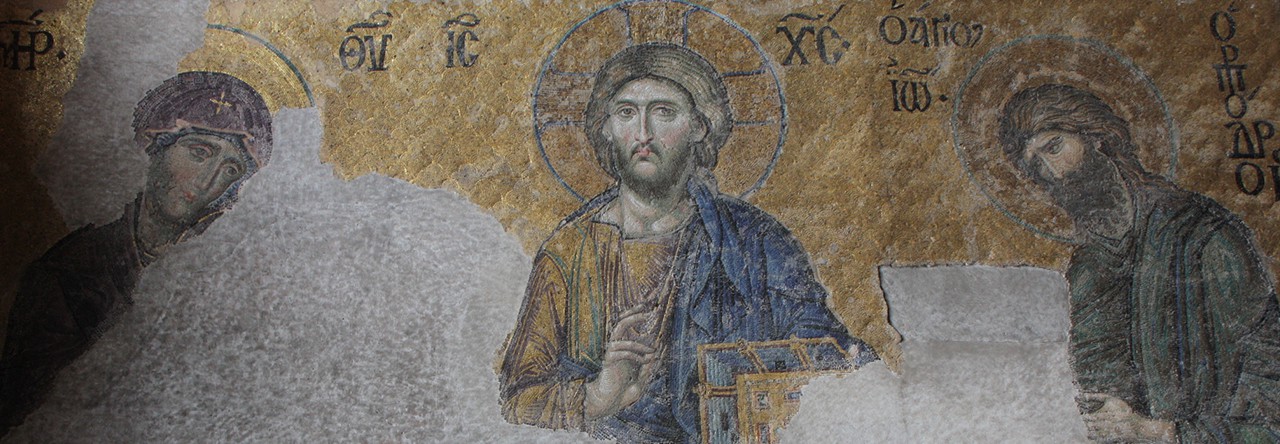

The next day John saw Jesus coming toward him, and said, “Behold! The Lamb of God who takes away the sin of the world! This is He of whom I said, ‘After me comes a Man who is preferred before me, for He was before me.’ I did not know Him; but that He should be revealed to Israel, therefore I came baptizing with water.” And John bore witness, saying, “I saw the Spirit descending from heaven like a dove, and He remained upon Him. I did not know Him, but He who sent me to baptize with water said to me, ‘Upon whom you see the Spirit descending, and remaining on Him, this is He who baptizes with the Holy Spirit.’ And I have seen and testified that this is the Son of God.” (John 1:29-34)

John the Forerunner was given by God the task of identifying the Messiah. The sign he was to look for was the Holy Spirit descending on someone and remaining on that person. The Spirit’s descent on the Christ would be visible to him. The Spirit’s coming again upon a human and then permanently abiding in that human was the undoing of a curse in Genesis which happened after humans began sinning:
Then the LORD said, “My spirit shall not abide in man for ever, for he is flesh, but his days shall be a hundred and twenty years.” (Genesis 6:3)

God withdrawing His Spirit from humanity was a spiritual death for all humans. Christ revivifies humanity by enabling the Spirit to dwell in us again.
The Evangelist John understands the Spirit’s descent on Jesus Christ to be an undoing of the curse which sin had brought on humanity – the rending asunder of God’s relationship with humans. Scholar and Bishop Irenaeus Steenberg in his introductory comments to St Irenaeus’ AGAINST THE HERESIES Book 3 (p 14) writes that Irenaeus believed the purpose of God becoming incarnate in Christ is exactly so that the Holy Spirit could abide in humans again, thus restoring humanity to its originally created state.

The Spirit descends upon the Son ‘when he had been made the Son of Man,’ and thus anoints the human Son with the Father’s breath, which vivifies all human creatures from the first (cf. Genesis 2:7). So the Spirit becomes accustomed, with Christ, ‘to dwell in the human race, and to rest among human beings, and to dwell in God’s handiwork, thus fulfilling the Father’s will in them and renewing them with their old selves for the newness of Christ.’

… Irenaeus begins explicitly to reflect on the ‘why’ of the incarnation – why the Son took human flesh and offered Himself at the cross, he had already emphasized . . . that this was to recapitulate and perfect the economy and Irenaeus stresses here that He thus refashions humankind, which ‘had been dashed to pieces by its disobedience’ and was unable to refashion itself. … The Christ, truly passable in His humanity, is able to suffer the cross and the tomb and thus rise from the grave …; and, so suffering as man in perfect obedience, He unites the suffering creature to the Father in the Spirit, causing him to participate a new in the divine life… The abiding mercy of the Father is thus manifest…, responding to the disaster of sin and transgression with the economy of self-sacrifice by which humanity may be restored in glory – and, ‘having been united with the Word of God and receiving adoption, might become a Son of God.
 Fraternized