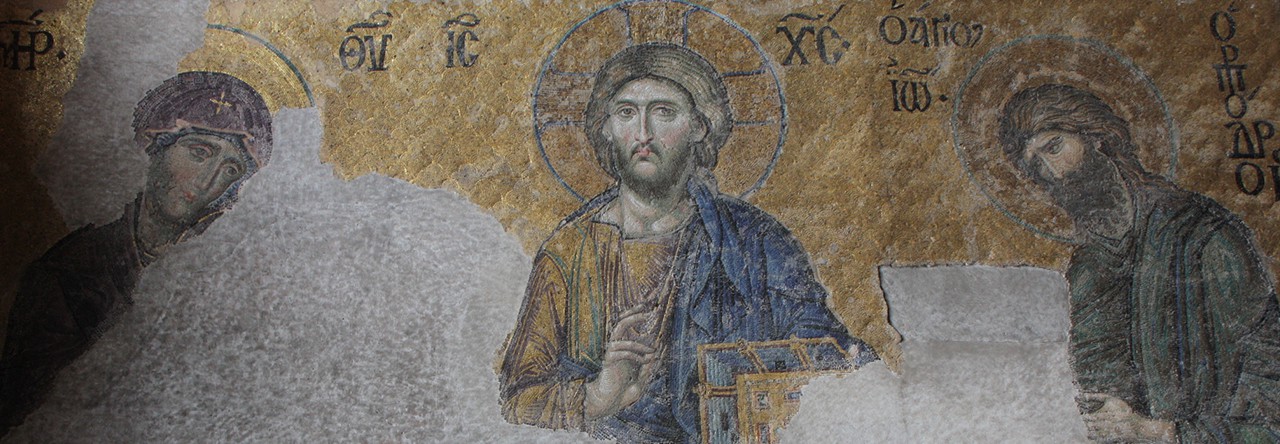

And Jesus answered them, “Those who are well have no need of a physician, but those who are sick; I have not come to call the righteous, but sinners to repentance.” (Luke 5:31-32)
Rev. Dr. Aleksei Volchkov in his article, Liturgy, Trauma, and Healing, offers a gentle critique of some common spiritual missteps in popular piety in the Orthodox Church surrounding going to (or receiving) Holy Communion. He writes that we don’t make ourselves worthy to receive Communion, rather Communion makes us worthy in God’s eyes:

There is a common idea about what it means to participate “correctly” in the Liturgy. In Orthodox discourse, one often hears that one should come to the Liturgy only after an inner purification; one should be free from sins, passions, and evil thoughts. Only then, it is said, does a person become “worthy” enough to participate in the Holy Eucharist.
Yet this idea can be deeply manipulative. It is often used in church rhetoric to underline the “unworthiness” of the laity and, by contrast, to highlight the “worthiness” of the hierarchy.

The truth is that none of us comes to the Liturgy in a state of purity. We come with our worries, doubts, and pain. We think about war, about tyrants, about the fate of our loved ones—about the cities we had to leave behind, and whether our children will ever see their grandparents again.
Worship is not a privilege reserved for the sinless.
Liturgy was not created for those who have already reached perfect calm, but for those who live amid a storm of emotions, including destructive ones: hatred, resentment, despair, a feeling of being betrayed, and the inability to forgive. We suffer, we are angry, we pity ourselves, we wish harm to others; and all of this is known to God.

Fr Volchkov is speaking directly to the Russian Orthodox Church in the following comments, but his words have meaning for all Orthodox Christians, who too often accept an “us versus them” understanding of liturgical prayers, wrongly assuming that such prayer is not for the entire world which God loves and wishes to save but only for the Orthodox (even though in the Liturgy we pray for the peace of the world, “on behalf of all and for all” and “for all mankind.”). For we are taught by Christ that we are to be a light to the world and the salt of the earth (Matthew 5:13-14).

Those who sow evil know very well that Liturgy can unite, console, and heal; that is precisely why they seek to capture it, to control it, to use it for their own ends. They infiltrate the worship through elements that are alien to it: through secular and military songs, through the display of flags—both civil and military—through “relevant” sermons that do not heal but reopen old wounds. At such Liturgies we hear, again and again, the division of the world into “us” and “them.” They affirm confrontation instead of reconciliation. Thus, the Liturgy, which should reveal the Kingdom of God, is turned into an arena of worldly struggle.

This is how liturgical exclusivism is born, when the practice of worship serves to strengthen boundaries instead of overcoming them. And often, church hierarchs give theological justification to this division, using people’s pain as a tool of self-assertion.
I believe the task of a priest today is to resist this tendency. Our pastoral care is to create in the church a space as inclusive and safe as possible.
 Fraternized