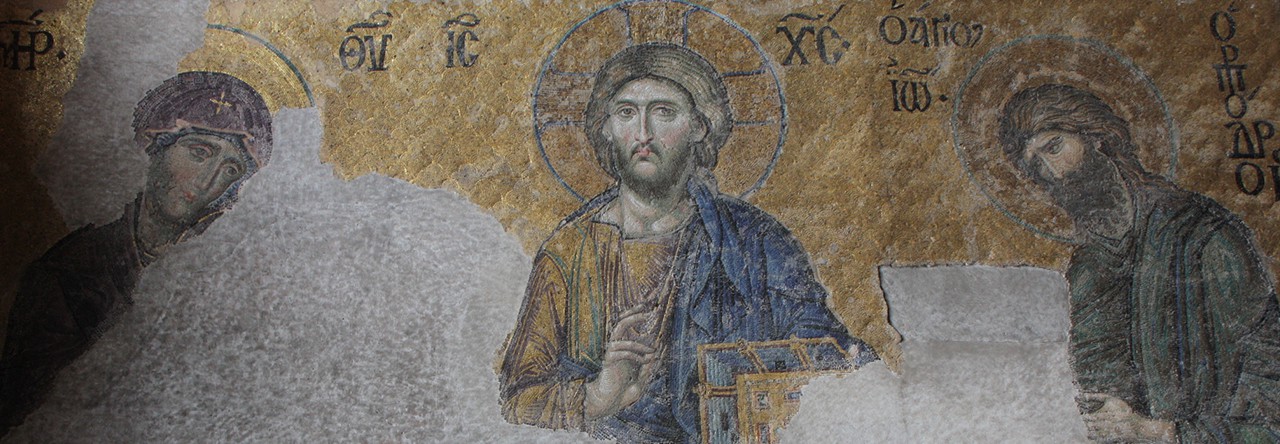

Recently I read a comment by a non-Orthodox biblical scholar which I found puzzling as a Christian statement. Professor Gregory Sterling wrote: “The story of Christianity begins with the historical Jesus” (SEEKING CHRIST IN THE SCRIPTURES, p 99).
To me the statement from a Christian faith perspective is troubling for a couple of reasons which I will explore in this post and the next.

First, there is the fact that the Jews themselves see in their Scriptures references to the Messiah. The story of Christ and Christianity begin in and with the Jews in the Old Testament. The Jewish Scriptures contain God’s prophecies and promises which prepare us for the coming of the Christ. The New Testament is peppered with these references to Old Testament prophecies. From the faith perspective of the early Church, the first writings about Jesus Christ are the entire Jewish Scriptures (aka, the Old Testament).

Second, we have Christ’s own words about those ancient Scriptures:
You search the scriptures, because you think that in them you have eternal life; and it is they that bear witness to me; yet you refuse to come to me that you may have life. . . . If you believed Moses, you would believe me, for he wrote of me. But if you do not believe his writings, how will you believe my words?” (John 5:39-47)

Christ claims Moses wrote about Christ – the Torah is about the Messiah Jesus. If you believe the Torah, you will believe in Jesus for it is the first written work about Him. That is where Christianity begins. We find the same message in Luke:
And he said to them, “O foolish men, and slow of heart to believe all that the prophets have spoken! Was it not necessary that the Christ should suffer these things and enter into his glory?” And beginning with Moses and all the prophets, he interpreted to them in all the scriptures the things concerning himself. (Luke 24:25-27)
We read the Jewish Scriptures in order to see Christ. This is a faith issue, embraced by the early Church, visible throughout the New Testament, and taught by the Church Fathers.

Jesus “before the Gospels” is what we find in the Old Testament. This is the first “portrait” of Jesus, though admittedly it is in shadows, prefiguration, and prophecies which all require interpretation. The early church saw Jesus everywhere in the Jewish Scriptures (though this way of reading the Jewish Scriptures may not sit well with some modern biblical scholars). The early church thought the anthropomorphic appearances of God in the OT were appearances of Jesus, the Second person of the Holy Trinity. As an eternal being, namely God’s Son, Jesus also has an ahistorical dimension. The more recent efforts by scholars to find the “historical” Jesus, may have some scholarly usefulness but one has to also consider that the Jesus of the Gospels is the Jesus that the Old Testament writers wrote about. Long before the Gospels are written, inspired writers were writing about the Christ. The very basis for early believers thinking Jesus is the Messiah is that He fulfils God’s prophecies and promises in the Jewish Scriptures.

Your father Abraham rejoiced that he was to see my day; he saw it and was glad.” The Jews then said to him, “You are not yet fifty years old, and have you seen Abraham?” Jesus said to them, “Truly, truly, I say to you, before Abraham was, I am.” (John 8:56-58)
Jesus is clear that the saints of the Old Testament were looking for Him and wrote about Him.
 Fraternized