Articles that I have read about the Russian Church document, “The Present and Future of the Russian World”, have deeply saddened me for that document portrays a Church which has abandoned its Gospel mission in favor of a nationalistic and imperial agenda. That document raises the Gospel question: “For what does it profit a man, to gain the whole world and lose his soul?” (Mark 8:36). The Church is supposed to equip each of its members to “attain to the unity of the faith and of the knowledge of the Son of God, to mature manhood, to the measure of the stature of the fulness of Christ” (Ephesians 4:13). That does not appear to be the goal of the Russian Church or of Patriarch Kirill as stated in its document. A good criticism of the document’s tenet is St Silouan who “was profoundly aware that evil can only be overcome by good. The use of force only leads to the substitution of one form of violence for another. . . ‘The Son of man is not come to destroy men’s lives, but to save them‘ (Luke 9:56). And this ought to be our one thought, too – that all should be saved’.” (THE MONK OF MOUNT ATHOS, p 92-93)
The Russian Church has veered off course and seems to have abandoned Christ’s new commandment by which the world would know that we are His disciples (John 13:35). The Russian Orthodox will be recognized as Christians only by acting in love toward their Ukrainian brothers and sisters, rather than viewing the Ukrainians as enemies to be annihilated or people to be forced into submission. St John the Theologian teaches us to “… love one another. And this is love, that we follow his commandments; this is the commandment, as you have heard from the beginning, that you follow love. For many deceivers have gone out into the world, men who will not acknowledge the coming of Jesus Christ in the flesh; such a one is the deceiver and the antichrist.” (2 John 5-7) For the Russian Patriarch to fail to practice love for his fellow Christians, his neighbors, his brothers and sisters in Christ is for him to reject Christ in the spirit of the anti-Christ.
Paul L. Gavrilyuk in his article, “When Theology Fuels the War”, writes a scathing critique of Russian Patriarch Kyrill and the Russian Church leadership for adopting the document, “The Present and Future of the Russian World.” This document proclaims that: “From the spiritual and moral point of view, the special military operation [namely the invasion of and aggressive war against Ukraine] is a Holy War, in which Russia and its people, defending the unified spiritual space of the Holy Rus’, fulfill the mission of the ‘Restraining One’ by protecting the world from the onslaught of globalism and the victory of the west that has fallen into Satanism.” Gavrilyuk says: “Apparently, by bombing Ukrainian cities Russia is engaging in the holy war and is preventing the end of the world. With the stakes being so high, any destruction, no matter how horrific, is justified; any amount of violence is acceptable in the fight of the absolute good (i.e. Russia) against the satanic evil (i.e. the west).” Patriarch Kirill “has repeatedly deployed and developed the same rhetoric of the holy war, going so far as to claim that the death of a Russian soldier in Ukraine is “a sacrifice that washes away all sins that a person has committed.” “The patriarch has turned the Russian Orthodox Church into an ideological machine of an aggressive state. None of his predecessors that claimed “loyalty” to the militaristic Soviet state could claim such a distinction. Some of them, often reluctantly, covered up the repressive actions of the regime against the believers. Patriarch Kirill, quite willingly, has supplied a political theology for a war that continues to destroy the lives and livelihoods of millions, some of whom he claims as his own flock (i.e. as the members of the Ukrainian Orthodox Church, Moscow Patriarchate).”
Alexander Motyl in his article, “The Russian Orthodox Church Declares Holy War on Ukraine”, notes “Even Putin hasn’t called his special military operation a holy war, though Kirill’s terminological innovation, which brings to mind the Crusades and Islamic Jihad, is perfectly compatible with Putin’s language.” Motyl says in the document, “Kirill shows his true face: ‘After the completion of the SMO [the war of aggression in Ukraine], the entire territory of modern Ukraine should enter the zone of exclusive influence of Russia. The possibility of the existence in this territory of a Russophobic political regime hostile to Russia and its people, as well as a political regime controlled from an external center hostile to Russia, must be completely excluded.” Kirill’s goals have nothing to do with the Gospel of Jesus Christ and are nothing more that imperialistic nationalism. Kirill is claiming an empire, the very thing Satan used to tempt Jesus. “Again, the devil took him to a very high mountain, and showed him all the kingdoms of the world and the glory of them; and he said to him, “All these I will give you, if you will fall down and worship me.” Then Jesus said to him, “Begone, Satan! for it is written, ‘You shall worship the Lord your God and him only shall you serve.’” (Matthew 4:8-10) Our Lord rejected Satan’s temptation, but Kirill appears to have embraced Satan and his offer for a worldly kingdom. In Luke 9:55, Christ rebuked His disciples for wanting to rain down fire from heaven upon the Samaritans. Kirill seems to be infected by that same evil spirit which possessed the two disciples for that wicked moment.
Serhii Shumylo in his devastating criticism of the Russian Patriarch, “Ordinary Fascism,” or The Russian World of Patriarch Kirill, writes that this new document contradicts a previous declaration of the Russian Church:
Every phrase of this paragraph completely contradicts the “Ten Commandments” (“you shall not kill”, “you shall not steal”, “you shall not bear false witness”, “you shall not covet “) and the Gospel ideals of love, peace, forgiveness, mutual respect, and non-violence. Indeed, any military invasions, aggression, murder, and violence cannot be termed or justified as “holy” from the standpoint of the Gospel. This is purely a pagan approach, where war was given special “sacralization” and “sanctification”, which fundamentally contradicts the teachings of Christ. It is probably no coincidence that in this document, ROC-MP, despite its pseudo-spiritual style and personal presentation by the Patriarch, there is no mention of the name of Christ or reference to the Gospel. … At the same time, this document contradicts the previously affirmed “Fundamentals of the Social Concept of the ROC”, where in the eighth chapter entitled “War and Peace,” it is noted that “war is evil”, and “killing, without which wars cannot happen, was regarded as a grave crime before God as far back as the dawn of the holy history.” (para. VIII.1), therefore “clergy and canonical ecclesiastical structures cannot assist or cooperate with the state” in matters of “political struggle”, “waging civil war or aggressive external war” (para. III.8.2), since “the Church endeavors to perform a peacemaking ministry…, also opposes the propaganda of war and violence, as well as various manifestations of hatred capable of provoking fratricidal clashes” (para. VIII.5). Thus, the justification by the leadership of ROC-MP of the aggressive war and the killing of tens of thousands of civilians in Ukraine, which they call a “holy war”, testifies to their distortion and perversion of Orthodox doctrine and disbelief in the basic tenets of Christ’s teaching.

Sister Vassa Larin writes a profound theological critique of the Russian church document, On “Heresy” and the Commemoration of Patriarch Kirill. She notes:
- Instead of the Triune GOD, not mentioned a single time in the “Edict,” we are called to believe in a “triune people” (триединый народ);
- Instead of CHRIST and SALVATION in Him, also not mentioned anywhere in the text, we are called to recognize the “Russian tradition, the shrines of Russian civilization and the great Russian culture” as the “highest value and meaning of life”;
- Instead of the CROSS and the WAY OF THE CROSS, we are called to the way of aggression and to a “Holy/Sanctified War” (Священная война), a term that justifies killing in the name of the above-mentioned “triune people”; instead of the SACRIFICE of Christian “witness” or MARTYRDOM, the patriarch proclaims as something salvific and sacrificial the “sense of duty” and “fulfilling of the oath” vis-á-vis a criminal regime (in the patriarch’s sermon of 25 September 2022);
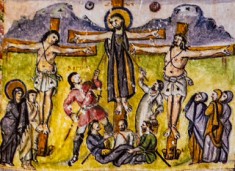
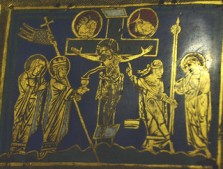
- Instead of the way of REPENTANCE, the way of the wise or penitent thief, we are called to the way of the other, not-penitent thief who was crucified to the Lord’s other side, i.e., the way of resentment and blaming everyone and everything else (see the resentment towards Ukraine, the “global” West, the law passed in Russia against “offending the feelings of believers,” – all supported by the Russian Orthodox Church)…
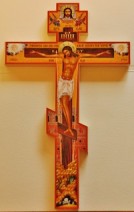
“… they crucify the Son of God on their own account and hold him up to contempt” (Hebrews 6:6).
When Patriarch Kirill blesses a military war against his fellow Christians which maims and kills thousands in the name of Russian nationalism, he rejects the Gospel. The only warfare of the Church, as St John Chrysostom noted, does not make the living dead, but rather makes the dead to live.









 Fraternized